Why PECS might not be the best tool for all AAC users
Augmentative and Alternative Communication (AAC) includes a wide range of approaches designed to support individuals who experience challenges with verbal language. One of the most widely known structured AAC systems is the Picture Exchange Communication System (PECS). It has been used extensively, particularly with individuals with autism and children with developmental communication needs.
What is PECS?
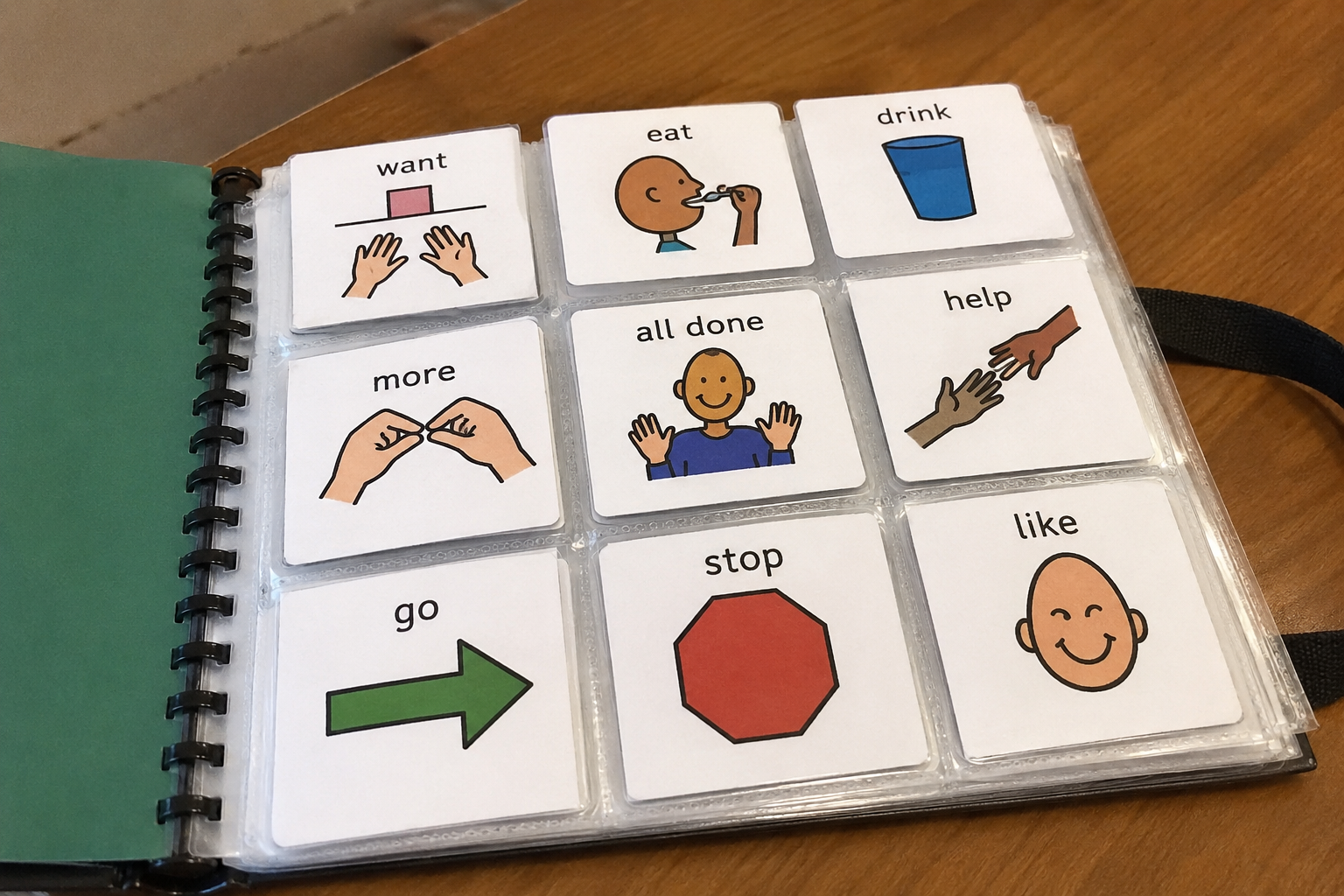
A generic picture exchange communication book (not the official due to the copyright)
PECS (Picture Exchange Communication System) is a structured AAC approach in which individuals learn to communicate by exchanging a picture or symbol for a desired item or action. It is typically taught in a step-by-step sequence, beginning with simple requesting (e.g., exchanging a symbol for a preferred item) and gradually progressing towards more complex communication functions such as sentence building and responding to questions. The system is highly structured and relies on consistent teaching procedures and reinforcement to develop communication skills.
While PECS can be highly effective for some learners, it is not always the most appropriate or sufficient AAC system for every individual.
PECS has a structured but limited communication model
PECS is built around a structured exchange system in which the learner hands over a picture symbol to communicate a message, often beginning with requesting. This structure can be highly supportive in establishing early communicative intent, particularly for individuals who are not yet initiating communication.
However, early PECS teaching often prioritises requesting over other communicative functions such as commenting, questioning, protesting, or sharing information. Unless explicitly expanded, this can result in communication that remains functionally limited in scope.
PECS being often positioned as a prerequisite to robust AAC
In some clinical and educational settings, PECS is used as an initial step before introducing more robust AAC systems such as speech-generating devices or complex communication books. In certain cases, professionals may require a child to demonstrate competence in PECS phases before being considered for other AAC modalities.
This practice can unintentionally delay access to full language systems. Current AAC best practice increasingly emphasises early access to robust AAC, even for beginners, rather than sequencing communication development through restrictive prerequisites. AAC is most effective when users are exposed to a full language system from the outset, allowing for natural language growth.
Robust AAC does not only refer to high-tech speech-generating devices. There are also several low-tech options that provide immediate access to a much wider range of vocabulary and language functions compared to PECS. These include levelled core boards, communication books, and flipbooks, all of which allow for quicker navigation of core vocabulary and greater flexibility in combining words to form more complex messages. These systems can support both early communicators and developing language users by offering consistent access to a broad and expandable language base.
The importance of autonomy in AAC use
A core principle of AAC is supporting autonomy and self-determination. Communication systems should enable individuals to make choices, express preferences, refuse, protest, and participate meaningfully in their environments. Highly structured intervention models, if implemented rigidly, may unintentionally reduce opportunities for spontaneous communication or limit the user’s control over when and how they communicate. This highlights the importance of ensuring that AAC interventions remain flexible and person-centred in practice.
Progression may plateau for some users
PECS is often effective in the early stages of communication development, particularly for teaching initiation and symbolic exchange. However, some individuals may experience a plateau in progress if the system is not expanded or transitioned into a more robust AAC framework.
At this point, many learners benefit from systems that support greater language flexibility, such as robust communication books or speech-generating devices with core vocabulary. Because PECS relies on physically exchanging symbols, it can sometimes be less efficient for expressing complex or rapidly changing messages. For users who are ready for more advanced linguistic development, AAC systems that allow quick access to a larger vocabulary and flexible sentence construction may better support expressive language growth.
It is important to note that when used flexibly and as part of a broader AAC plan, PECS can play an important role in a child’s communication journey.
Moving towards a person-centred AAC approach

Rather than viewing PECS as a standalone long-term solution or mandatory prerequisite, it is often more effective to consider it one possible step within a wider AAC framework. For many individuals, the goal is not only to request, but to develop a rich, flexible, and self-directed communication system that supports participation across all areas of life.
A person-centred AAC approach involves ongoing review, responsiveness to the user’s needs, and ensuring that the communication system evolves alongside the individual.
